Why Base Prep Makes or Breaks Your Turf
Poor base preparation causes 80% of artificial turf failures. Learn what a proper base costs, what materials to use, and what happens when you skip it.
The turf you see is the least important part of the installation. What's underneath it (the base) determines whether your artificial lawn drains properly, stays flat, and lasts 20 years or fails in three. Poor base prep causes roughly 80% of premature artificial turf failures, according to installers who've been called to fix someone else's work.
This guide explains what a proper base is, what it costs, and why the shortcuts homeowners try almost always backfire.
Why the Base Matters So Much
Artificial turf doesn't grip or repair itself the way natural grass does. Natural grass roots bind to soil, self-level minor irregularities, and channel water downward through living root systems. Artificial turf has none of these properties. It's a manufactured surface that reflects every flaw in what's underneath it.
A bad base creates three specific problems:
Uneven surface. Any ridge, hollow, or soft spot in the base telegraphs directly through the turf pile. You'll see bumps, waves, and dips in the finished surface, and they get worse as the base continues to settle unevenly. Foot traffic accelerates this.
Poor drainage. Pooled water under turf creates anaerobic conditions. This leads to bacteria growth, odor, and rapid breakdown of the turf backing's adhesive and fibers. A properly engineered base drains at least 30 inches per hour. A poorly prepared clay base might drain at 0.5 inches per hour: fast enough to appear fine in light rain, disastrous in a heavy storm.
Base migration. Compacted aggregate that wasn't properly locked in place migrates under load. Over time, high-traffic areas develop depressions while adjacent lower-traffic areas remain elevated. This creates a wavy surface that's impossible to fix without pulling up the turf.
The Three Base Configurations
Our calculator includes three base options that reflect real installation practice. Each one breaks down like this.
No Base ($0/sq ft)
This isn't really "no base." It means no additional base work is needed because an adequate base already exists. This applies specifically to:
- Concrete or pavers in good condition with adequate drainage slope
- Existing compacted crushed aggregate that's level and drains properly
- Rooftop or deck installations with proper structural support
If you're installing over bare soil, low-compaction areas, or clay, "no base" means skipping essential work. That's not a cost saving. It's a liability.
Basic Base ($1.50/sq ft)
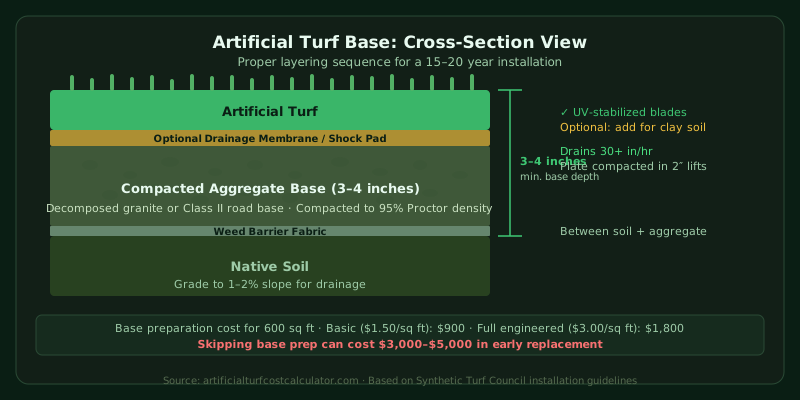
A basic base involves excavating 3–4 inches of existing material and replacing it with compacted decomposed granite or class II road base. That $1.50/sq ft covers:
- Labor to excavate 3–4 inches across the full area
- 3–4 inches of crushed aggregate material
- Compaction with a plate compactor in two directions
- Final grading to achieve 1–2% drainage slope
For a 600 sq ft backyard, that's $900 in base materials and preparation, and it's money that directly protects the turf above it.
The basic base works well for most residential applications on well-draining native soil. It's not appropriate for clay-heavy soil, areas with high water tables, or applications with heavy foot traffic like sports fields or commercial areas.
Full Engineered Base ($3/sq ft)
A full base adds a drainage membrane, sometimes a shock pad, and often additional depth of aggregate. It's appropriate for:
- Installations over clay or poorly-draining soil
- Areas with known drainage issues or seasonal standing water
- High-traffic applications (kids' play areas, pet runs, commercial entries)
- Installations over impermeable surfaces (concrete, asphalt) requiring a drainage layer
For a 600 sq ft installation, the full base adds $1,800 to the project cost. Here are the complete numbers:
- Premium turf ($7.50 × 600): $4,500
- Full base ($3.00 × 600): $1,800
- Zeolite infill ($1.50 × 600): $900
- Professional labor ($3.50 × 600): $2,100
- Total: $9,300
Compare that to the same turf with no base on existing soil: $7,500. The $1,800 difference in base cost is real money, but if the soil under that installation doesn't drain, you're pulling up a $7,500 investment and starting over in 3–5 years.
Use the artificial turf cost calculator to model different base configurations for your square footage and see the cost difference directly.
What "Proper Compaction" Actually Means
The most commonly cut corner in DIY base installation is compaction. A plate compactor (rental: $80–$120/day) delivers 3,000–5,000 lbs of compaction force per square foot. A hand tamper delivers 150–200 lbs. That's not a 20x difference in convenience. It's a 20x difference in how well your base will hold up.
Properly compacted base aggregate:
- Achieves 95% standard Proctor density (the engineering spec for stable base material)
- Won't compress further under foot traffic or vehicle weight
- Retains its drainage properties because aggregate particles are locked in contact with each other
You can't achieve this with hand compaction. Installers who skip the plate compactor are either inexperienced or cutting costs at your expense.
Best practice: Compact base material in 2-inch lifts. Spread 2 inches, compact, then spread another 2 inches and compact again. A single 4-inch lift compacted once doesn't achieve the same density as two properly compacted lifts.
Drainage Slope: The Detail That Prevents Disasters
Water flows downhill. That's the entire foundation of drainage design. Your base must be sloped at 1–2% away from structures (house foundations, retaining walls) to give water a path.
How to verify slope: Use a 4-foot level and measure the drop over 4 feet. A 1% slope drops 0.5 inches over 4 feet. A 2% slope drops about 1 inch over 4 feet. You want somewhere in that range consistently across the entire area.
Flat bases rely on the turf perforations and aggregate pore space to drain vertically. This works in light rain but fails in heavy rain events when the drainage rate can't keep up with precipitation. A 1% slope to a natural drainage point means gravity helps even in heavy rain.
The Weed Barrier Question
Weed barrier fabric (landscape fabric) goes between the native soil and the aggregate base, not between the base and the turf. This is a common installation error.
Placing weed barrier under the aggregate: correct. It prevents soil from migrating up into the aggregate layer and keeps weed seeds from establishing below the base.
Placing weed barrier on top of the aggregate, under the turf: blocks drainage. Liquid pools on top of the fabric instead of draining through the aggregate. This creates exactly the standing water problem you're trying to prevent.
Red Flags in Contractor Quotes
When you're getting bids, watch for these base-prep warning signs:
"We don't need to excavate, we'll just install over what's there." This is only acceptable on concrete or existing aggregate. On native soil, it's a guarantee of future problems.
No mention of compaction equipment. Ask specifically whether they're using a plate compactor. If the answer is no, that's a problem.
Base depth under 3 inches. Three inches is the minimum for a stable residential base. Less than that means inadequate compaction depth and increased risk of settlement.
No discussion of drainage slope. A contractor who doesn't bring up drainage direction hasn't thought through your installation properly.
A reputable installer will walk your site, check existing drainage patterns, identify any low spots, and specify base depth based on your actual conditions. Generic quotes that don't mention site assessment should prompt additional questions.
For the DIY installer, our full step-by-step base prep guide is in the how to install artificial turf walkthrough.
Want to see the full cost impact of different base choices for your specific area? Calculate your installation budget with our free tool.
Related Articles
How to Install Artificial Turf: DIY Guide
Installing artificial turf yourself saves $3.50/sq ft in labor. Learn the step-by-step DIY process, tools needed, and what to watch out for.
artificial turf
How Long Does Artificial Turf Last?
Artificial turf lasts 8–25 years depending on grade and installation quality. Learn what affects lifespan and how to get the most from your investment.
Artificial Turf Cost Calculator Team
We build free, accurate home improvement calculators grounded in real contractor pricing data.