Artificial Turf vs Real Grass: 10-Year Cost
Artificial turf costs more upfront but natural grass expenses add up fast. See the real 10-year cost comparison with specific numbers.
A 1,000 sq ft lawn looks simple enough on paper. Natural grass: plant it and mow it. Artificial turf: install it and forget it. But over 10 years, the dollar figures tell a very different story, and the winner might surprise you depending on where you live and how you maintain things.
This is a direct, numbers-first comparison. No vague claims. Just actual cost of ownership.
Year 1: The Big Difference
Natural grass installation for a bare-dirt area (seed or sod) typically costs $0.15–$0.90/sq ft for seed or $0.90–$2/sq ft for sod. For a 1,000 sq ft lawn using sod, you're looking at $900–$2,000 for the material, plus $800–$1,500 for professional installation. Call it $1,500–$3,500 in year one.
Artificial turf on the same 1,000 sq ft plot is a different conversation. Using mid-range turf at $5/sq ft, a basic base at $1.50/sq ft, silica sand infill at $1/sq ft, and professional labor at $3.50/sq ft:
- Turf: $5.00 × 1,000 = $5,000
- Base: $1.50 × 1,000 = $1,500
- Infill: $1.00 × 1,000 = $1,000
- Labor: $3.50 × 1,000 = $3,500
- Year 1 total: $11,000
You can verify these numbers with our artificial turf cost calculator. The gap at year one is significant: roughly $8,000–$9,000 more for artificial turf.
So when does synthetic grass break even? Time to track the ongoing costs.
Annual Maintenance: Natural Grass
These are real annual costs for a 1,000 sq ft lawn in a typical U.S. suburban setting:
Water. Lawn irrigation uses roughly 1 inch of water per week during the growing season (about 26 weeks). That's 1,627 gallons per 1,000 sq ft per week, or about 42,000 gallons per year. At the national average of $0.004–$0.008 per gallon, you're spending $170–$340 annually just on water. In drought-prone states like California or Arizona, water rates are significantly higher. Assume $300/year as a national midpoint.
Mowing. DIY mowing costs roughly $150–$300/year in fuel, time, and equipment wear on a 1,000 sq ft lawn. Professional mowing (bi-weekly during growing season) runs $25–$40 per visit, about $325–$520/year.
Fertilizer. Four applications per year at typical retail pricing: $120–$200.
Weed control. Pre-emergent and spot treatments: $50–$150/year.
Aeration and overseeding. Annual fall aeration and overseeding for a healthy lawn: $150–$300.
Pest and disease treatment. Occasional: $0–$200/year depending on your region and lawn health.
Conservative annual total: $790/year. High-maintenance or drought-region total: $1,300+/year.
Annual Maintenance: Artificial Turf
Artificial turf maintenance is genuinely minimal. Here's what you'll actually spend:
Brushing. A power broom or stiff brush keeps blades upright. Equipment cost amortized over 10 years is negligible. Time cost: 2 hours per year.
Rinsing. Occasional hose-down for debris, pet waste, or pollen: minimal water cost, maybe $20–$40/year.
Infill top-up. Every 3–5 years, you'll need a partial infill refresh. Budget $200–$400 total per event, maybe $60/year amortized.
Weed prevention. Weeds can still grow through seams or edges. Annual treatment: $30–$80.
Repairs. Minor seam repairs might be needed once or twice in a 10-year span. Budget $100–$300 total.
Conservative annual total: $150/year.
The 10-Year Math
| Cost Category | Natural Grass | Artificial Turf |
|---|---|---|
| Year 1 installation | $2,500 | $11,000 |
| Annual maintenance × 10 | $7,900 | $1,500 |
| 10-year total | $10,400 | $12,500 |
At the 10-year mark, artificial turf still costs about $2,100 more for a 1,000 sq ft area. But quality artificial turf lasts 15–25 years, and natural grass maintenance costs keep climbing. For more on turf longevity, see our guide on how long artificial turf lasts.
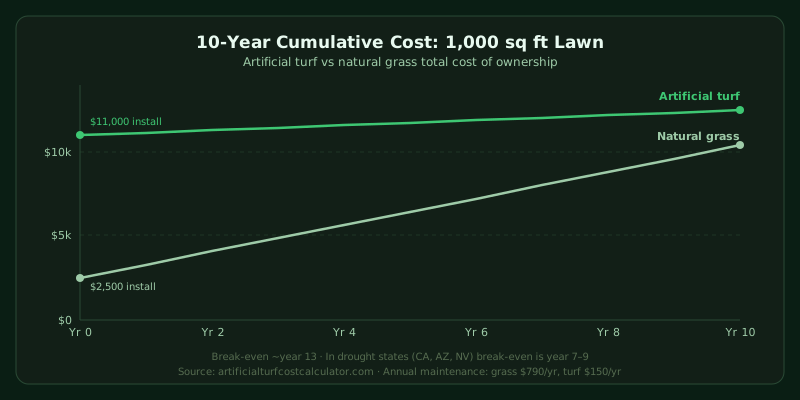
Year 15 projection:
- Natural grass: $10,400 + (5 × $790) = $14,350
- Artificial turf: $12,500 + (5 × $150) = $13,250
By year 15, artificial turf pulls ahead. In high-water-cost regions like California, Arizona or Nevada, where annual water costs alone can run $600–$1,200, the break-even point moves to year 7–9.
The Water Factor
This is where the comparison shifts most dramatically by geography. In Southern California, residential water rates can be $0.008–$0.015/gallon or higher during drought surcharges. That same 1,000 sq ft lawn using 42,000 gallons/year costs $336–$630 in water alone, before any drought surcharges or tiered pricing penalties.
Over 10 years: $3,360–$6,300 just in water. Artificial turf almost pays for itself in water savings in drought-prone areas.
Property Value: Does Turf Help or Hurt?
This one's genuinely mixed. In water-scarce regions and HOAs where water restrictions apply, artificial turf often adds value or at least maintains it. A National Association of Realtors survey found that 71% of buyers said lawn appearance affected their purchasing decision, but the preference between natural and synthetic varies by market.
In lush, rainy regions like the Pacific Northwest or Southeast, natural grass tends to be preferred by buyers and may have a slight edge. In the Southwest and California, artificial turf is often seen as a premium feature.
Side-by-Side: What You Actually Give Up
Natural grass pros:
- Lower upfront cost
- Cooler surface temperature (turf gets hot: see our heat solutions guide)
- More "natural" aesthetic preference for many buyers
- Easier small repairs (just reseed)
Artificial turf pros:
- Zero mowing
- 80–90% water reduction
- Stays green year-round
- Ideal for pets and heavy foot traffic areas
- No fertilizer or pesticide runoff
Which Is Right for You?
The 10-year math favors artificial turf if you're in a water-restricted area, have heavy foot-traffic areas, or have pets. It's essentially a wash for most other homeowners, but you buy back significant time and effort.
If you want to see what installation would cost for your specific square footage and turf grade, try our free turf calculator. And for the full picture on where artificial turf costs come from, read our guide to artificial turf pricing in 2026.
Find out more about how we source our cost data on our about page.
Related Articles
How Much Does Artificial Turf Cost in 2026?
Artificial turf cost ranges from $3 to $12+ per sq ft installed. Get real numbers, breakdown by material and labor, and estimate your project cost.
artificial turf
How Long Does Artificial Turf Last?
Artificial turf lasts 8–25 years depending on grade and installation quality. Learn what affects lifespan and how to get the most from your investment.
Artificial Turf Cost Calculator Team
We build free, accurate home improvement calculators grounded in real contractor pricing data.